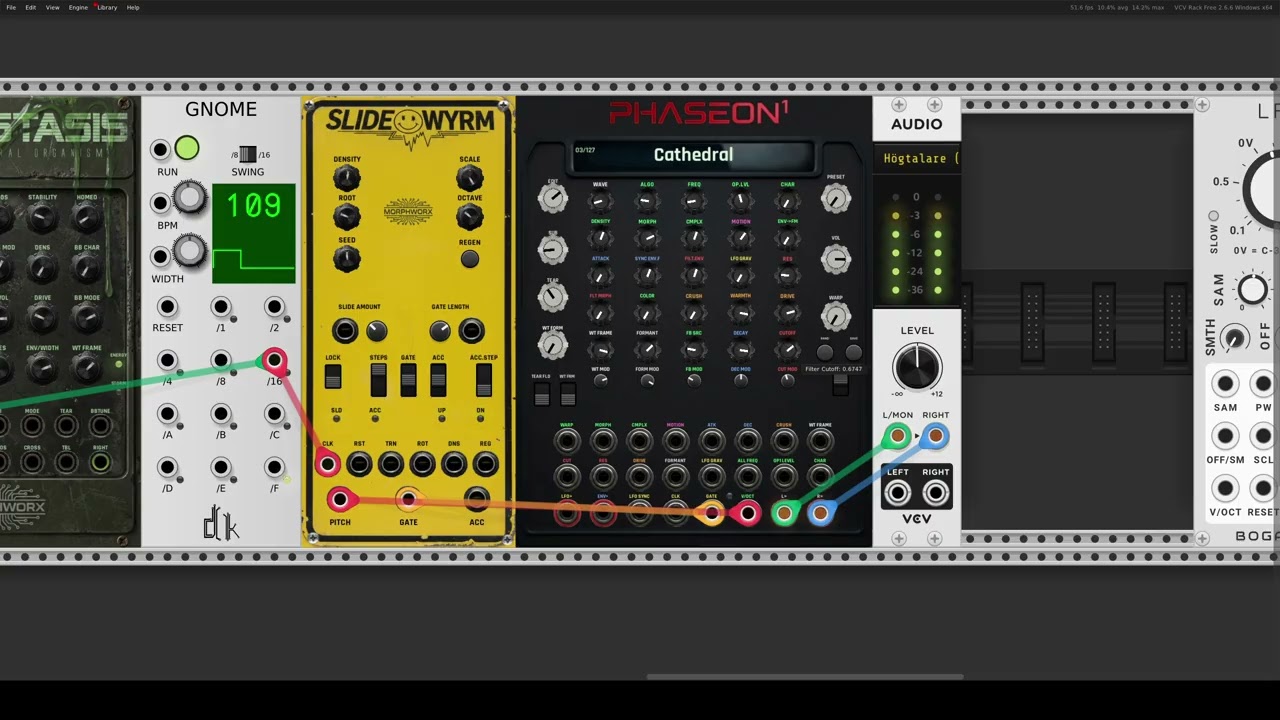
Messing around with Phaseon synth voice + the drum modules and SlideWyrm (TB3PO port)
Messing around with Phaseon synth voice + the drum modules and SlideWyrm (TB3PO port)
these look (and from what i can tell, sound) amazing! really looking fwd to trying them all out whey they’re good and ready
Phaseon had to be scaled back and revised due to some performance issues on metamodule.
But its now better than before. Has a state variable filter and a ton of other changes. Sounds supreme for bass guitar, dubstep and just weird stuff. I think there’s a gap where this stuff just doesn’t exist for eurorack (Something Serum-like, something with presets, its not something you are going to find).
outdated a bit (yesterday’s build)
But yes, coming along nicely, i spend 8-9h on this daily, have been since i started! 
Phaseon 1 is done, has around 60 presets now. 49% CPU @32Khz. Tons of new stuff, maybe i’ll do a video walkthrough or at least i’ll make a manual for it because its a lot to unpack.
Xenostasis got some updates too, most notable; a ladder/comb filter
Browsing some presets on Phaseon1… (i do need to do buttons instead, its awful browsing with a knob):
Working on drumkits for the AMENOLITH multi-sample drum player and then i need to put
together a preset bank for MINIMALITH (preenFM2), oh, it also got some nice upgrades that arent in the hardware version, a TEAR function (wavefold-style saturation, noise, and a short comb/delay feedback) and way better glide.
Hi Vurt
The Phaseon sounds really good with loads of different sound possibilities.
Do you think you can add a cv input for preset selection?
Yes, that could be a good idea. I’ll add that + come up with 2 more so the ports are consistent.
Thanks Vurt, that’s awesome! 
TRIGONOMICON was updated with 20 EBM patterns, 20 techno/electro patterns and 20 Gqom patterns. There are now 120 patterns in total.
So the styles are now
Breakcore
Amen/Breakbeat
Jungle
IDM
EBM
Gqom
Dub
DnB
Techno
Electro
Then there are some others odd ones, uk garage, odd time signatures and a few others.
The MUTATE function got updated too, in the range around 90-100% everything basically turns into breakcore / IDM with ratchetting etc. I think i will also add a on/off switch for something even more extreme, not sure yet how to exactly do it.
Some musical clips of how the modules sounds together
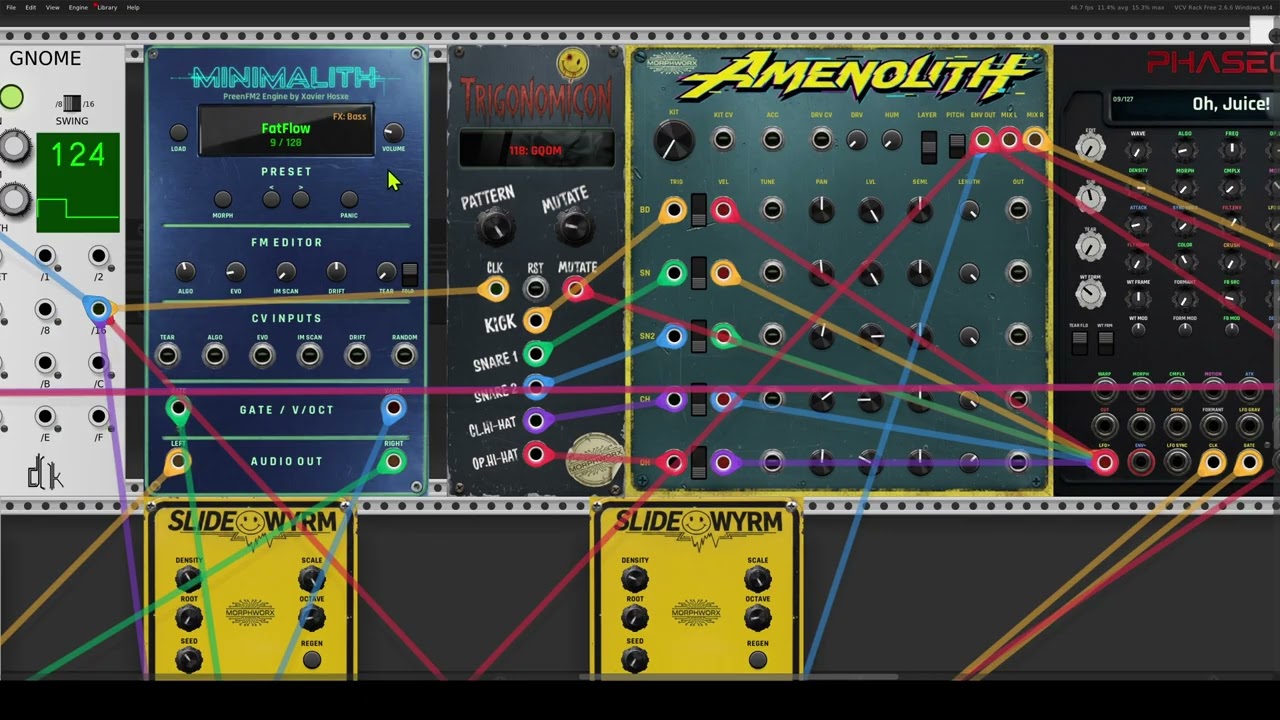
The AMENOLITH got an ENV out added, works really well to drive certain parts of SLIDEWYRM with, like Density, i use it in the first clip.
Since AMENOLITH will need great sounding snares i am now training an AI model with 14700 snare hits using acids-ircam/RAVE: Official implementation of the RAVE model: a Realtime Audio Variational autoEncoder
we’ll see how that goes. i’ll move on to doing a model of Kicks after that.
This will allow me to do proper soft,medium,hard hits, without it sounding like the drums are from different kits.
I already almost nailed it by just using a .py script that very carefully went through all of my drums and categorized them by how they sound (pitch etc), but it would be fun to have my own endless supply of drums, so hopefully it works. It will take the whole day to train if not more.
Bah, i do not recommend RAVE for drums.
First of, almost impossible to setup, at least on Windows. Got it working after 5-6h of struggling with the myriad of dependencies. But as time went on i got more and more aware that this model is not made for drums at all really but more for vocals and e.g strings or long synth sounds, it does not work well for short sounds.
Switched to ddspsfx which seems to be a much better fit for drums after reading up. So i hope that works.
Oh, and Trigonomicon now has a FILL function, can be quite useful. It makes various things depending on voltage.
“CV state / What happens
Rising edge (>1V) Enters breakdown — voices start muting based on voltage
1–3V gate Kick + hats play, snares drop (lightest)
3–5V gate Kick only (stripped down)
5–7V gate Hats only (ethereal)
7–10V gate Full silence (maximum tension)
Falling edge (<1V) Fires a generative fill, intensity proportional to voltage
Fill intensity scales with voltage:
Low voltage (1–3V) → gentle fill: kick doublet, light hat roll
High voltage (7–10V) → explosive fill: all 5 voices, up to 6 kick hits, 12 hat hits, snare drags — spanning 2 clock periods”
There is still some tweaking to do, like the “FILL” function on Trigonomicon needs to be updated properly on the faceplate. But here’s a first release of some of the modules. Untested but i think it’s correctly packaged. I can test tomorrow, too tired right now.
Release v0.1.0 - Initial Release · vurt72/MorphWorx
Phaseon1 - 4-op PM/FM synth with wavetable and formant shaper
Trigonomicon - Generative drum trigger pattern generator
Septagon - Polyrhythmic drum patterns in 7/4
Xenostasis - Autonomous hybrid synthesis organism
Hi Vurt
Got my 4MS summary in my email then had a thought on your creations.
I read that you added some nice performance feature
Here to send some support
Thanks again!
I added Side-chain In on both Phaseon1 synth-voice and on the PreenFM2 port.
Also as Output + Internal (on/off) on the new Analog-style drum-machine (FerroKlast).
While this is not exactly hard to setup in modular i thought why not just include it on the modules, less patching.
FerroKlast has Accent In for the Accent Out on TRIGONOMICON, and it also received a “Groove out”. This is just a CV out which follows the groove from the drums. Here’s the Agent explaining it:
On FERROKLAST, GROOVE out is a slowly evolving CV voltage (0–10V) that reflects the current “character” of the groove being played. Think of it as a mood meter for the whole drum pattern in real time.
Here’s what shapes it:
Which drum hit — each voice (kick, snare, clap, rim, etc.) pushes the voltage toward a different “home position” on the 0–10V range. For example, a rim shot pushes it high. This means the output naturally rises and falls as different voices fire in sequence.
Accent — louder, accented hits push the voltage higher and make it more dynamic.
Cymbal/metal activity — hihats, ride, voices don’t directly snap the voltage to a new position; instead they build up a hidden “metallic energy” memory that gradually bleeds into the overall output, adding pressure the busier the top end gets.
Knob settings (Color, Decay, Body, Material, Chaos) — these tweak the target position slightly, so turning knobs changes the range of motion.
The output glides smoothly between values (slewrate coefficient ~0.02) rather than jumping — so you never get hard steps, only gentle drifts.
What can you patch it to?
Anything that benefits from evolving with the pattern — filter cutoff, reverb mix, an LFO rate, a VCA, a pitch offset. Patching it to a filter and playing a busy groove will make the filter naturally open when the pattern gets dense and close when it’s sparse. It’s a one-jack “pattern energy” analyzer.
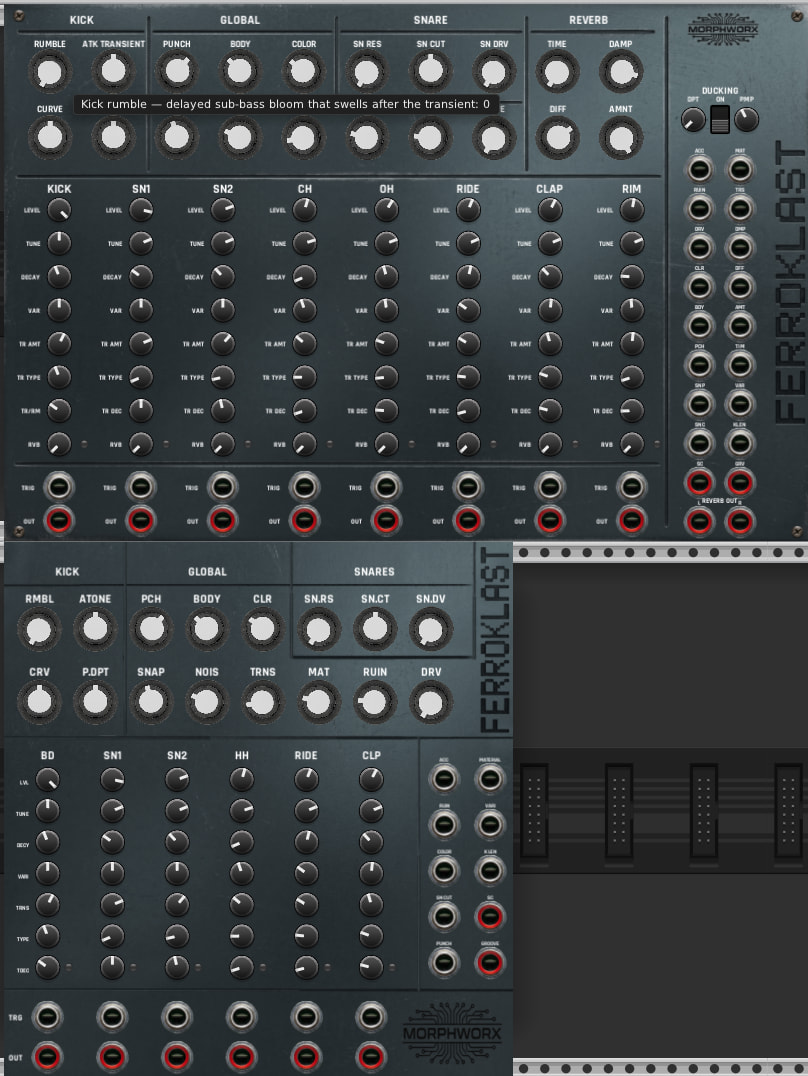
Built the MM version of FERROKLAST. This is much easier on the CPU, Clap and Hi-hats + Ride is samples instead of synthesis. Rimshot was removed to cut down on number of voices. Reverb was removed and internal sidechaining. Also “RUIN” is simplified, for MM version there’s just Decimate instead of Decimate+Bitcrushing+ByteBeat.
It’s around 30-40% CPU, depending on your settings.
Comparison shot:
Cool! Keep us updated 
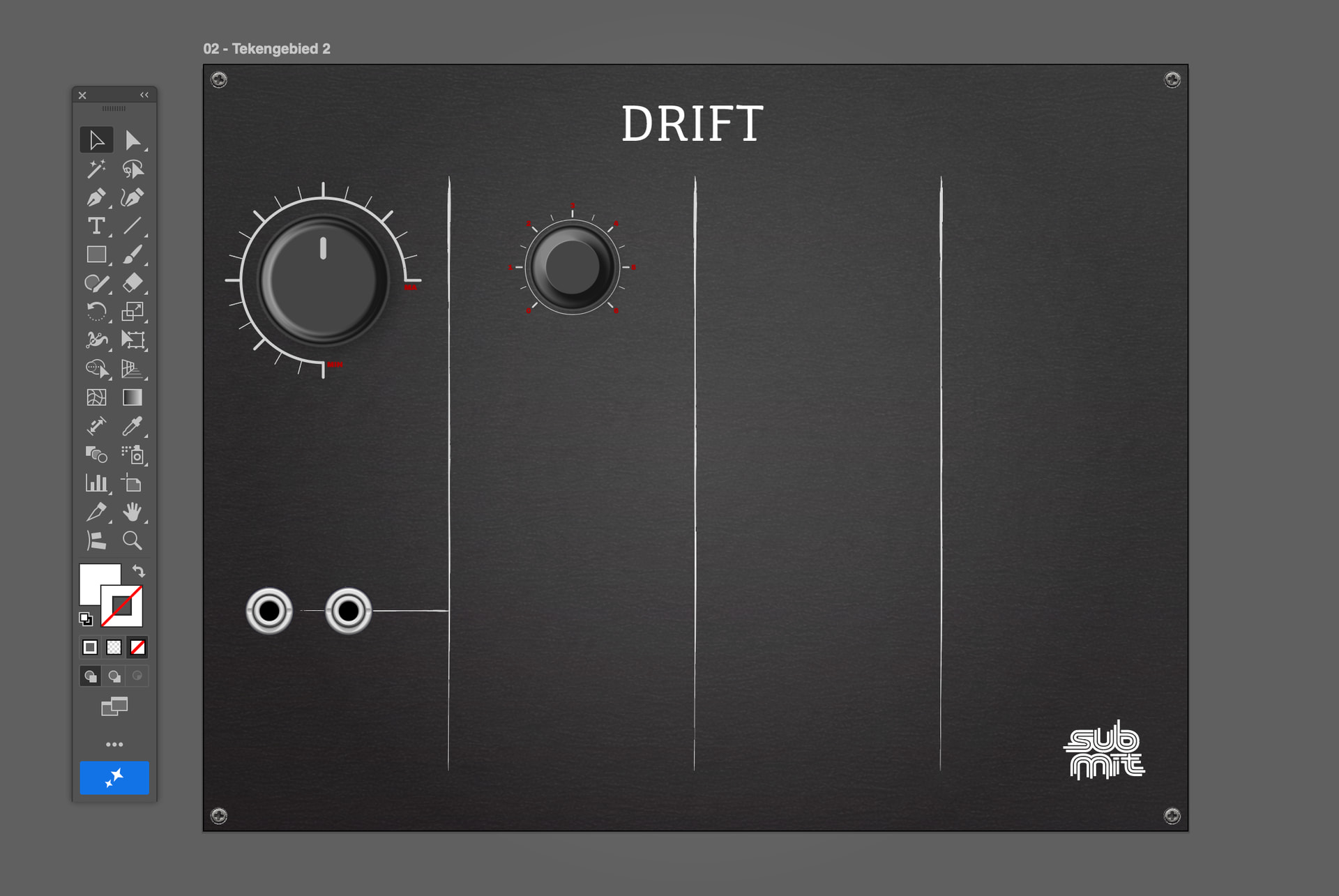
Design update: the panel is almost finished.
Layout and structure are in place, just a few small tweaks left. The main focus now is cleaning things up and making everything consistent.
Next step is translating all vectors into SVG for VCV, making sure everything scales properly and stays sharp in the module.
More soon.
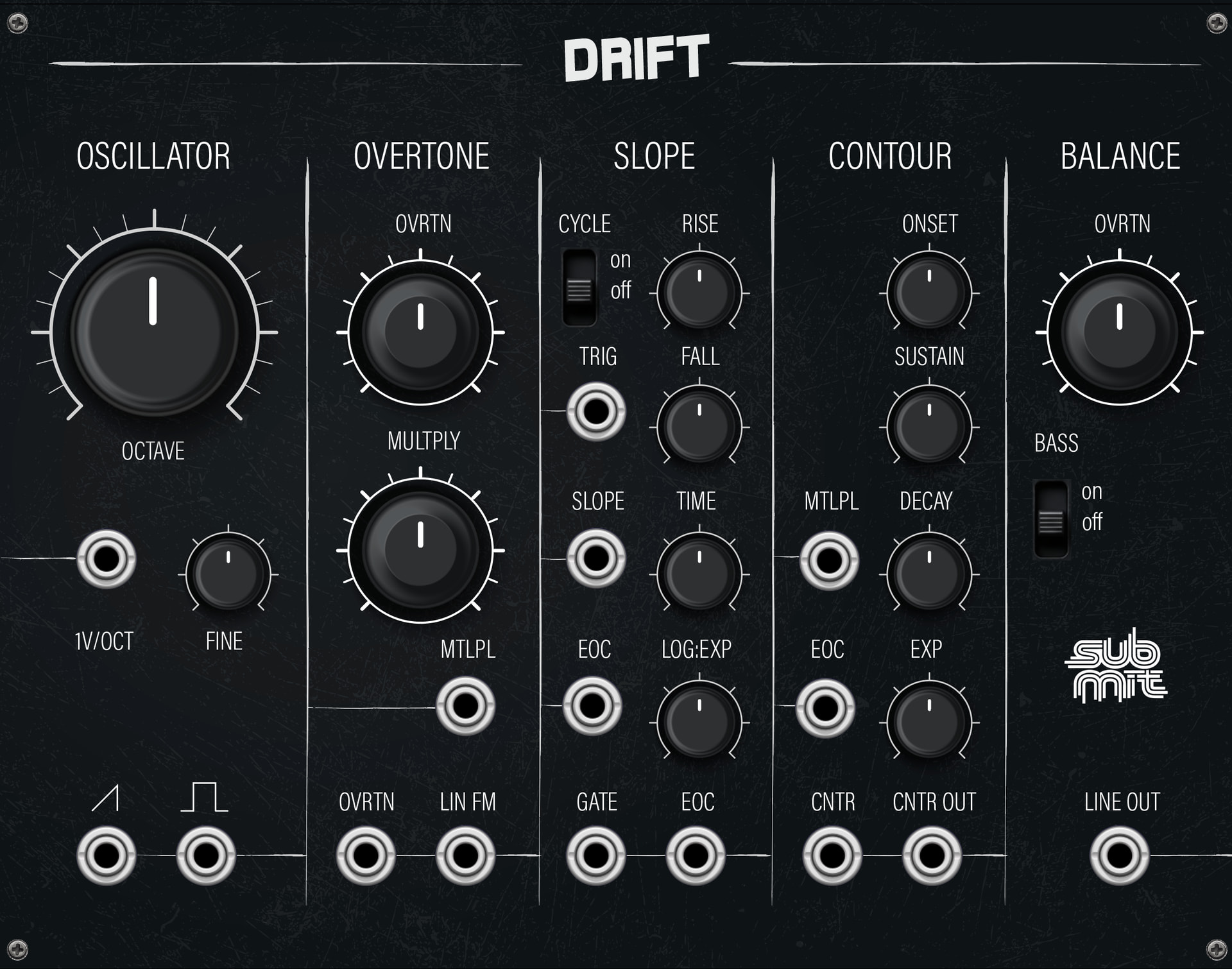
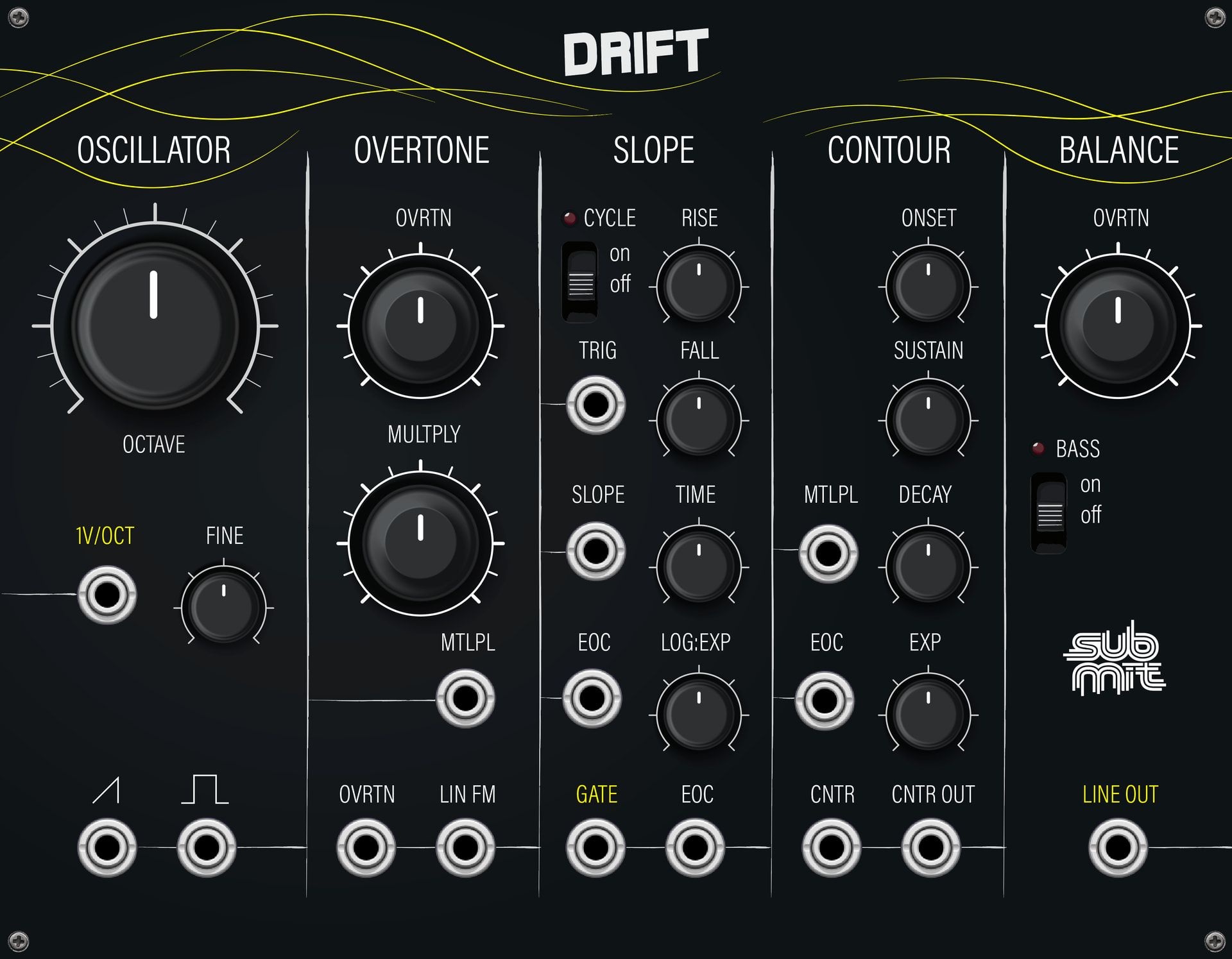
My first module is almost finished! I found out that making knobs with gradients was quite complex, so I ended up redesigning them. The sound is exactly what I wanted. Now I’m working on fine-tuning the sound in VCV.
That is a nice looking module! Can’t wait to hear it