This patch came from a very simple and not very original idea: Wouldn’t it be nice to have a polyphonic synthesizer using Plaits’s melodic (green and orange) modes, much like the Oxi Coral and the Arturia MicroFreak. The answer is yes, it is quite nice.
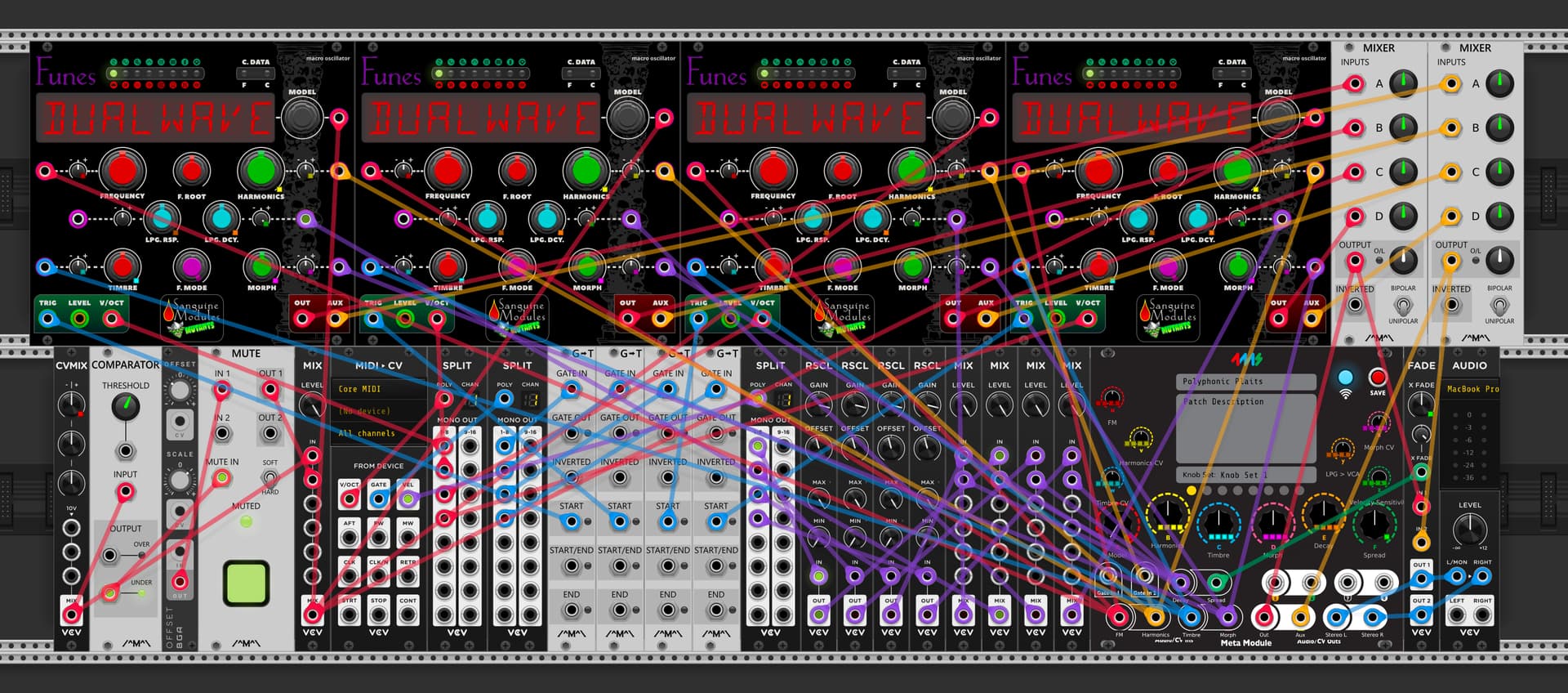
Polyphonic Plaits.vcv (5.2 KB)
Polyphonic Plaits.yml (21.8 KB)
Plug in a MIDI keyboard or sequencer, pick a model with Knob A, wiggle the other knobs to taste, and enjoy some extremely rich-sounding chords.
Some notes:
-
Plaits originally had eight pitched models (green) and eight percussion models (red). The v1.2 firmware added eight more pitched models (orange). This patch is set up to use the pitched models — first the original green ones, then the new orange ones. We use Sanguine Mutants Funes instead of Cloned Instruments Plaits because it has the v1.2 models and some other nice features.
-
One of those nice features is a big digital display that tells you what model you’re using. You can see it in the patch on the Meta Module, or even zoom in on that display from any of the Funes menus.
-
Plaits has an internal envelope and a low-pass gate/VCA, which combine to give many of the models their distinctive plucky sound. You can control the decay time of the envelope and LPG manually, or with CV; they also respond to MIDI velocity, which response you can scale with the Velocity Sensitivity knob. You can make the plucks sound more like an LPG/VCFA (darker, more “organic”) or more like a VCA (brighter, more “synthetic”) using the LPG > VCA knob. (Everything in this bullet point is possible thanks to yet more nice features of Funes. Thanks, Bloodbat!)
-
One thing to remember about Plaits: The internal envelope is normaled to Timbre, Morph, and FM. With the Timbre CV, Morph CV, and FM attenuverters in the center, that doesn’t have any effect, but if you adjust those knobs you’ll start hearing those parameters change with each note, even with nothing plugged into the associated CV inputs. FM, in particular, can make your nice patch get seasick very quickly.
-
Plaits has two outputs that emit distinct but related signals for each model: Out and Aux. We’ve got Out coming from Output 1, Aux coming from Output 2, and the two of them together, in stereo, from Outputs 3 & 4, with a handy crossfader to pan them. Sending an LFO to the Spread input is fun.
-
This patch was inspired by the Unperson’s excellent video series on Plaits, which made me want to spend a bunch of time with this ubiquitous yet still delightful module.
-
The fact that Émilie Gillet gave all this code away so other people could make music with it is an extremely beautiful thing.